Meetkunde & Taal · Geometry & Language · 20 / 20
The Quantum Origins of Language
How meaning might collapse out of possibility, in kana and in mind.
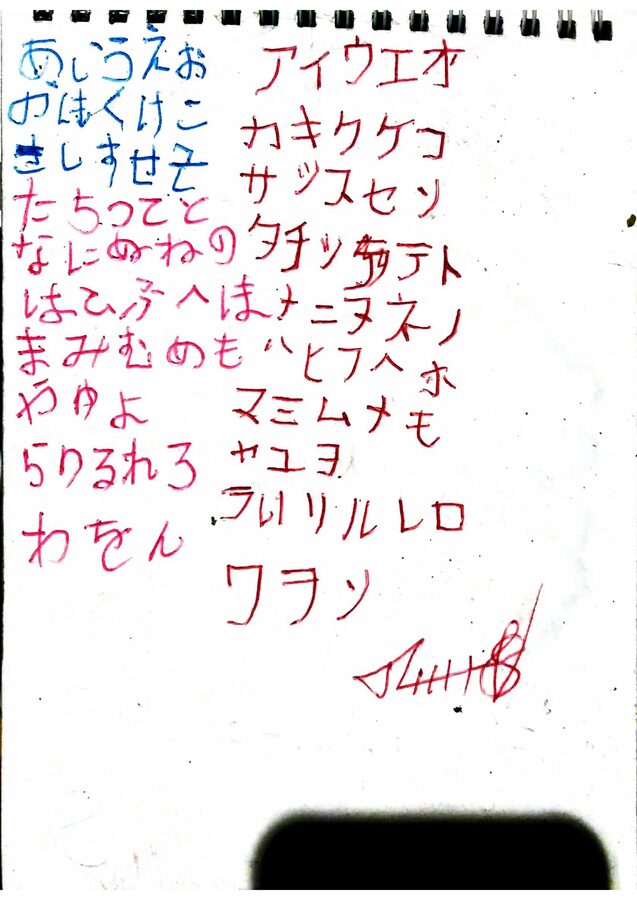
Start with a heresy. Suppose language is not a human invention at all — not a tool we assembled from grunts and firelight and grammar — but something that was already there, waiting in the fabric of things. The source excerpt proposes exactly this: that language began as a primordial quantum event, an atomic spark struck at the inception of the universe. In the same instant that the Big Bang made the first atom, it made the first act of communication. Everything you will ever say was, in this telling, folded into that spark.
It is a wild claim, and the essay knows it. But follow the intuition rather than the physics, because the intuition is genuinely lovely. Before there were symbols, before sound or syntax, the original language was pure communication — an instantaneous transmission of meaning that owed nothing to time, space, or culture. Not words about the thing, but the thing itself, resonating. Every tongue we now speak is a descendant of that, a slowing-down and thickening of something that was once immediate.
Collapse into form
Here is where the quantum metaphor earns its keep. The primordial atom of language, the excerpt says, held within it the potential to become all spoken and unspoken languages at once. That is a superposition — a haze of everything-possible that has not yet chosen. And to speak, to write a single kana onto a page, is to make it choose. Possibility collapses into this word, this stroke, this sound, and in the collapsing it becomes definite and loses all the others it might have been.
Language is not merely a system of symbols but a dynamic, evolving force tied to the entanglement of particles.
You feel this every time you reach for a word and find three, and pick one, and watch the other two dissolve. Meaning does not exist in the abstract and then get transcribed. It arrives by narrowing. The essay's poetry is to insist that this narrowing is not merely psychological but cosmic — the same gesture the universe made when it first spoke itself into atoms.
Geodesics, or why Italian is not Chinese
If all languages share one quantum root, why do they sound like different worlds? The excerpt answers with geometry. Language, it argues, is geodesically distributed — shaped by the paths that particles and information trace through the space-time of a place. Just as different regions carry different gravitational fields and their own curvature, the languages grown in those regions were bent by their own local field. Chinese and Italian are, at the quantum level, the same language; on the surface they diverge because they crystallised along different geodesics.
From this the essay draws a striking claim about identity. Your native language is not a coat you put on but a shape your cognition took, a manifestation of your cultural and quantum reality. This is why a Chinese speaker fluently speaking Italian can produce a faint dissonance — a shift in the geodesic identity of the words, a body carrying a field that the sounds did not grow from. The idea rhymes with linguistic relativity, the old Sapir–Whorf notion that the language you speak shapes the world you can see — but pushed further, until the language is not just tuning your perception but wiring you to the quantum field of the people you came from.
Beyond the last word
Once language is loosed from human throats, the excerpt lets it wander. If communication is a property of the quantum field, it need not stop at Earth: alien species might speak in frequency, vibration, or entanglement itself, transcending sound entirely. And it need not stop at death. The essay speculates, gently, about an afterlife language — a shift into another field, a non-verbal transmission of meaning that persists once the body's syntax falls silent. You do not have to believe any of this literally. It is enough to sit with the underlying insistence: that beneath every difference, all speech is one thing, still radiating from a single spark.