Die Kwantum-Self · The Quantum Self · 16 / 20
The Echo in the Cold: Seven Bells
A story of a man who is a choir, and the bells that keep the dead in their place.
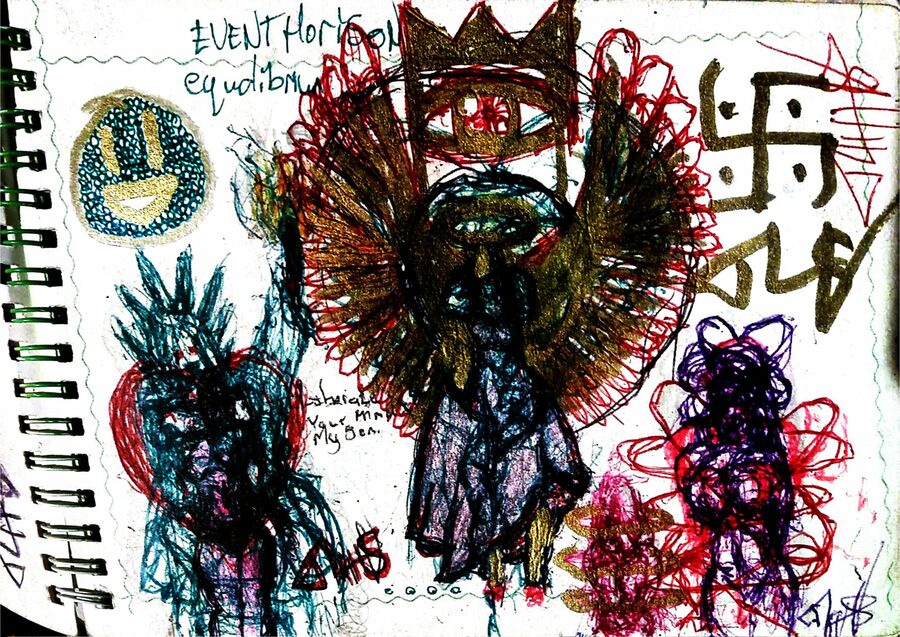
Thomas is not a single man, though his boots feel heavy enough in the knee-deep snow of the Old Kingdom. To anyone watching, he is a tall figure in a tattered surcoat, a bandolier of seven silver bells against his chest. But in his own mind he is a choir. Thomas-Past keeps watch on the perimeter. Thomas-Future, shimmering and translucent, whispers to focus on the rhythm of the Charter. Thomas-Current, meanwhile, is trying not to freeze to death. This is the story's first and best joke — and its deepest claim. The self it describes is not one voice but a chorus of its own moments, arguing across time.
We usually picture a person as a single thread pulled taut from birth to death. The story asks you to picture something stranger and truer: a weave. When the Mordicant bursts from the drift, Thomas leans into a defensive stance he has not yet learned — a gift, the text says, from a warrior-self residing in a distant, dusty century. He is not remembering. He is harmonising. The past and future selves are not memories and predictions; they are participants, drawn into the present moment to hold the line.
The bells that keep the dead in their place
Seven silver bells hang at his chest, and each is a kind of grammar for time. The one the story lets us hear is Kibeth, the Walker. When Thomas rings it, the monster does not die. It unravels — forced to remember the path it had forgotten, the path toward the First Gate. This is the story's quiet thesis about the dead, and about the past in general. The Mordicant, we are told, was merely "a lost thought given terrifying form," a tangled knot of magic that had lost its way.
Read that as a claim about your own interior. The past does not become monstrous by existing; it becomes monstrous by refusing to stay where it belongs. A memory left to wander out of its proper hour arrives as resentment, as a creature of charred bone and peat-fire. The bell does not destroy it. It walks it home. To keep the dead in their place is not to forget them — it is to grant each moment its right position in the weave.
He didn't just see the monster; he saw the fraying threads of its spirit. The creature didn't die; it unraveled.
The Oversoul and the full stop
When the veil thins, Thomas is summoned before a seven-foot figure in black robes who calls himself the result of Thomas's specialisation — "the full stop at the end of the sentence." Death, here, is not an enemy. He is the boundary that lets the sentence mean anything at all. And what he guards is the Oversoul: the collective consciousness of all the Thomases across time, the whole choir gathered into one held note.
The story then does something lovely. It reaches far forward to Sarah Thomas, a Senior Architect in the year 2400, standing in a museum before the bell called Ranna. When her hand closes on the cold silver she feels the freezing slush of the Old Kingdom through a dead man's boots. Her blueprints for a Trans-Temporal Bridge, she realises, are the modern interpretation of the ancient Charter — the same work of holding back the dark, written in a different notation. Where the future counterparts see a stream of data and the warden sees a river, both are describing one continuous self, asked to harmonise its own frequencies across the centuries.
That is the quantum self this section keeps circling. You are not a point moving along a line. You are a superposition of your own hours, and agency is the ringing of the right bell — the act that summons your scattered selves into one chord and sends the wandering dead back down the path toward the Gate. When it is done, the story says simply: the bridge was built. The Oversoul was intact.