Die Kwantum-Self · The Quantum Self · 12 / 20
The Disreputable Dog on the Things That Remember
Loyalty, purpose, and memory — dictated by a dog who is more than a dog.
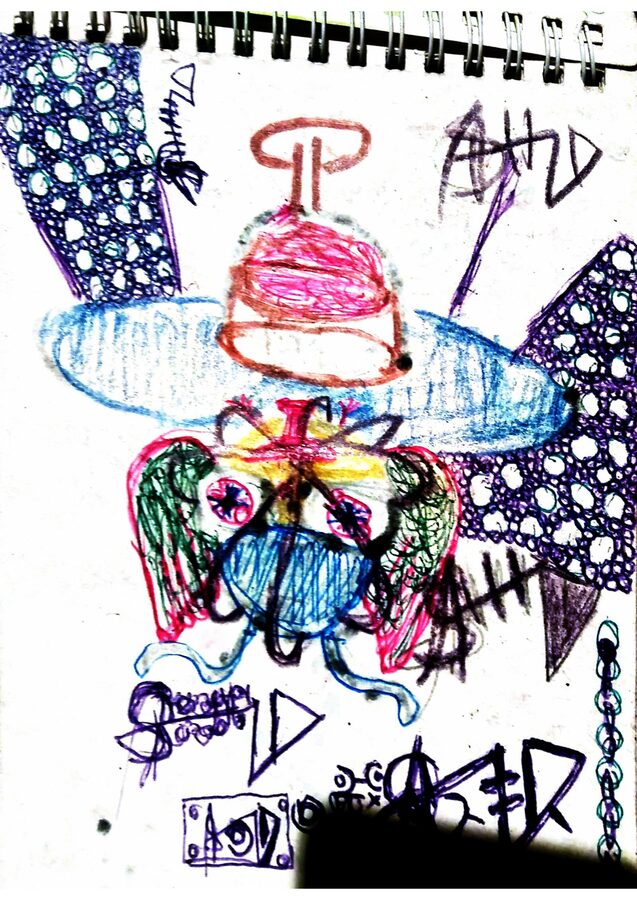
The Disreputable Dog will not tell you what she is. She insists this is not evasion but the correct epistemological position: what she is is better demonstrated than described, and she has spent several thousand years demonstrating it. What she will tell you is what she knows. And what she knows, in this essay dictated through a chorus of collapsed wavefunctions, is that loyalty, purpose, and memory are — in the end — the same thing.
What loyalty is not
She begins, as she says all good things begin, with the negative space. Loyalty is not obedience. Obedience is the performance of compliance, the external matching of behaviour to instruction; a locked door is obedient. It needs no relationship between the compliant thing and the authority, only the correct wiring. Loyalty is the choice to stay oriented toward something after the wiring has failed and the instructions have run out.
Nor is loyalty attachment. Attachment clings; it reaches for the thing it loves and tries to stop it moving, changing, becoming something it did not anticipate. Attachment says stay. Loyalty says I will go where you go. The Dog does not fasten herself to any particular Abhorsen, any particular configuration of the work. The individual changes across generations; the Dog remains, because she is loyal to the principle the Abhorsens embody — the keeping, the ringing of the bells with understanding rather than mere technique. Her loyalty is to the song, not to any single singer.
And loyalty is not unconditional support. This is the one that causes the most confusion. The Dog does not agree with everything the Abhorsen does; she has watched them make mistakes from the personally catastrophic to the cosmically inadvisable, and she has said so, and she will say so again. Loyalty that cannot include honest disagreement is not loyalty — it is sycophancy wearing loyalty's coat, and sycophancy is a dangerous thing to happen to a person with real power. She loves them enough to tell them when they are wrong. That is the luxury of the genuine article: you do not have to manage the relationship. You can tell the truth instead.
Loyalty as a technology
What loyalty is, then, is a sustained orientation — the choice, made and remade in every moment, to remain pointed at something larger than your immediate comfort. Comfort and convenience are powerful gravitational forces, and holding a line against them is a continuous act of will most beings find increasingly expensive over time. The Dog does not find it effortless. That is precisely the point: the things that are genuinely difficult and genuinely sustained mean more than the things that simply happen.
But loyalty is also, past all sentiment, practical. It is a technology. When the Abhorsen faces a Mordicant in knee-deep snow, with Thomas-Past shouting in one register and Thomas-Future whispering in another, the Dog's presence is not decorative — it is structural. She holds the environment stable enough for work to happen. She is the steady frequency against which the other frequencies measure themselves.
You can improvise freely when there is a reliable rhythm section beneath you. You cannot improvise at all when the rhythm is uncertain. The Dog is the rhythm section of the Old Kingdom.
The things that remember when everything else forgets
Deepest of all, loyalty is a form of memory. When the Entity found the thread and began pulling — unwriting the record of the Thomases one by one — what held was not cleverness, not power, not the bells. What held was the Dog's knowledge of what everything was for. She remembered the purpose while the purpose was under assault. This is what loyal companions do in a crisis: they become the external memory of your own best self, the living record of your intention, kept safe by someone who has loved that intention so long it has become part of who they are.
The Oversoul works the same way. Beneath its tactical uses, it is a memory system — and what it remembers is not the technique, which can be learned, nor the bells, which can be inherited, but the quality of the commitment: the specific texture of carrying the weight and choosing, today, again, to keep carrying it. That feeling cannot be reconstructed from external records. It has to be transmitted directly, person to person, generation to generation. Break the chain and you keep the technique but lose the understanding — and technique without understanding is the Mordicant, the thing that moves in the right direction but has forgotten why. Purpose, the Dog reminds us, is a vector, not a point: not a destination you arrive at and rest, but an orientation you keep. Loyalty is how a self stays legible to itself across time. You cannot erase who someone is trying to be as long as something loves them enough to remember.