Scientific Computing · General Relativity
5D Manifold
Solver_
An installable, tested Python package that computes the curvature of a five-dimensional Schwarzschild-Verhave metric — deriving the Einstein tensor analytically and mapping the transition from a shell to a regular black hole.
Overview
This packages my computational general-relativity work into a clean, reproducible repository. It numerically and analytically studies a five-dimensional, two-time ("Schwarzschild-Verhave") metric: it computes the Einstein tensor in closed form and maps the shell→regular-black-hole transition at the critical coupling αc = rs²⁄4. It's a portfolio piece that shows I can take exploratory research scripts and turn them into tested, installable, CI-backed software.
Highlights
∑ Analytic Einstein tensor
Curvature is derived in closed form rather than purely numerically, then cross-checked against numerical evaluation.
🕳️ Regular black-hole mapping
Locates the critical coupling where a singular shell becomes a regular (singularity-free) black hole.
✅ Tested
17 passing pytest checks: Bianchi identity, Schwarzschild limit, vacuum solution, grid convergence — plus the cosmology suite (de Sitter horizon, supernova fit, quintessence).
📦 Engineered, not scripted
Refactored a real side-effect bug (import-time plotting) into clean solver / figures modules with a CI workflow and a v0.1.0 release.
Update v0.2.0 — Dark energy & cosmology
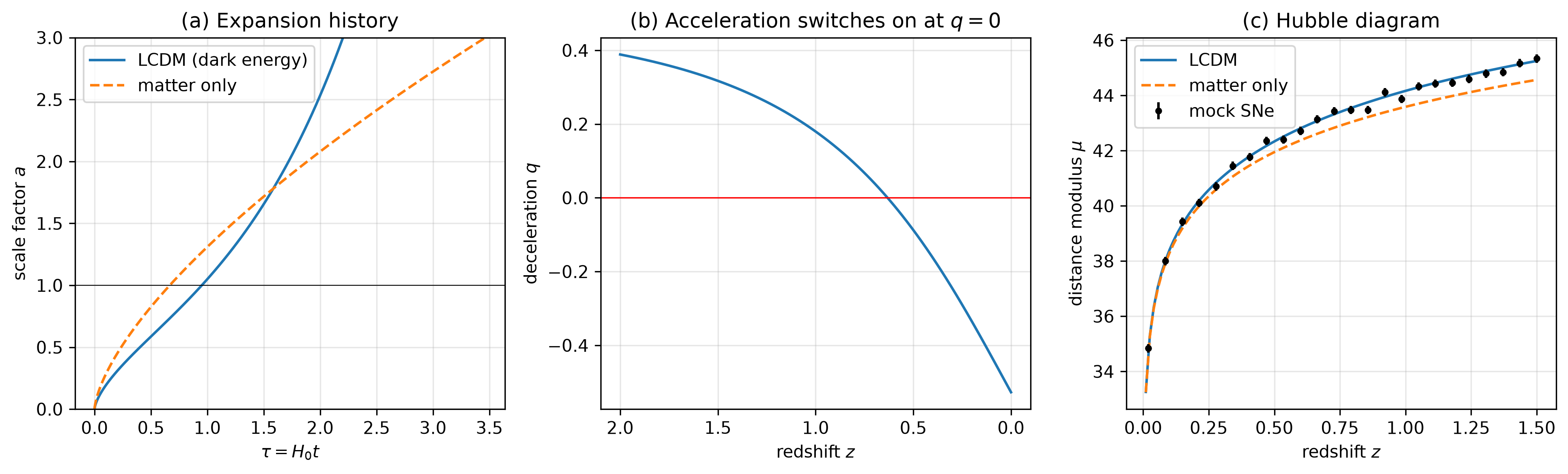
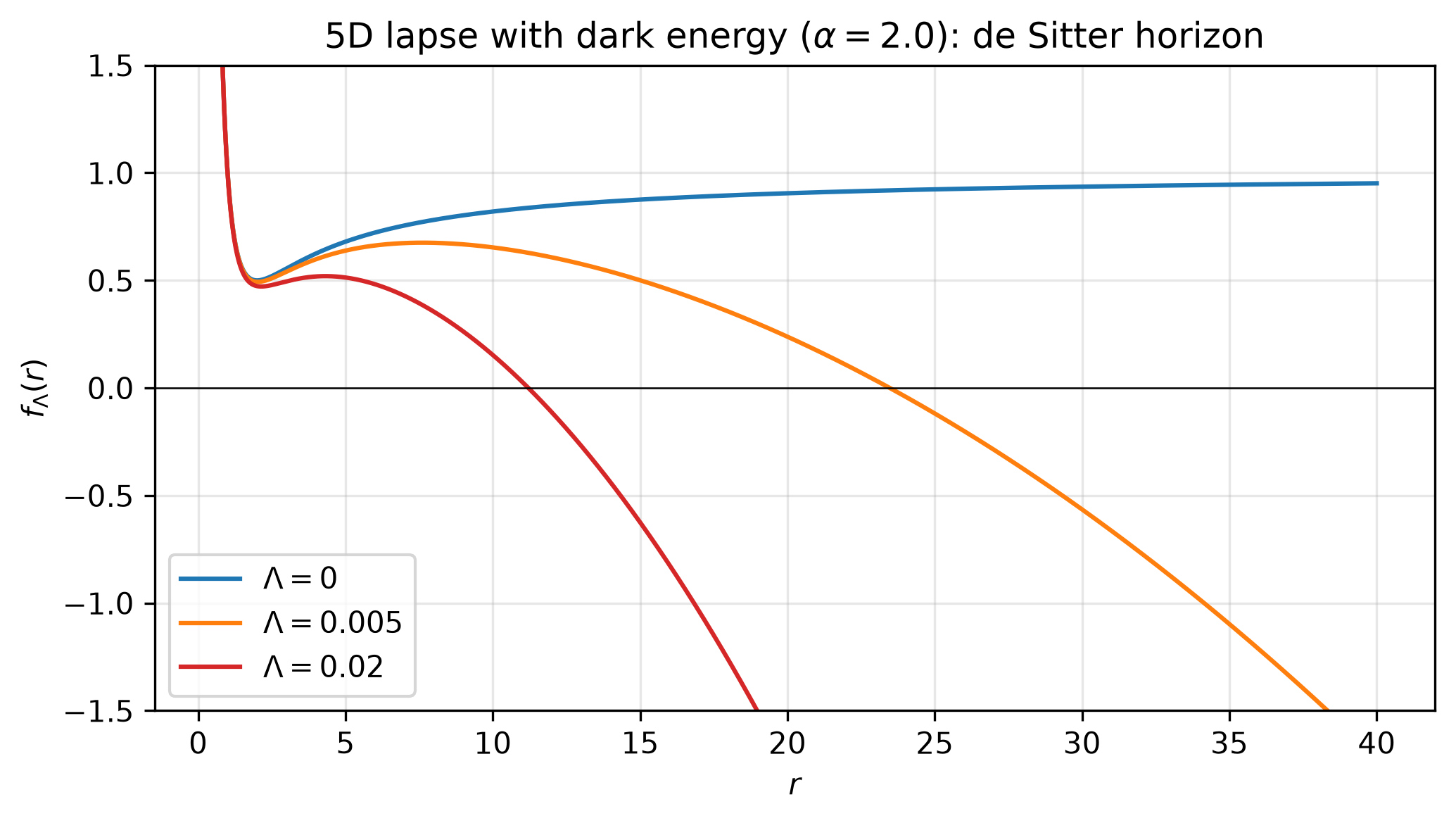
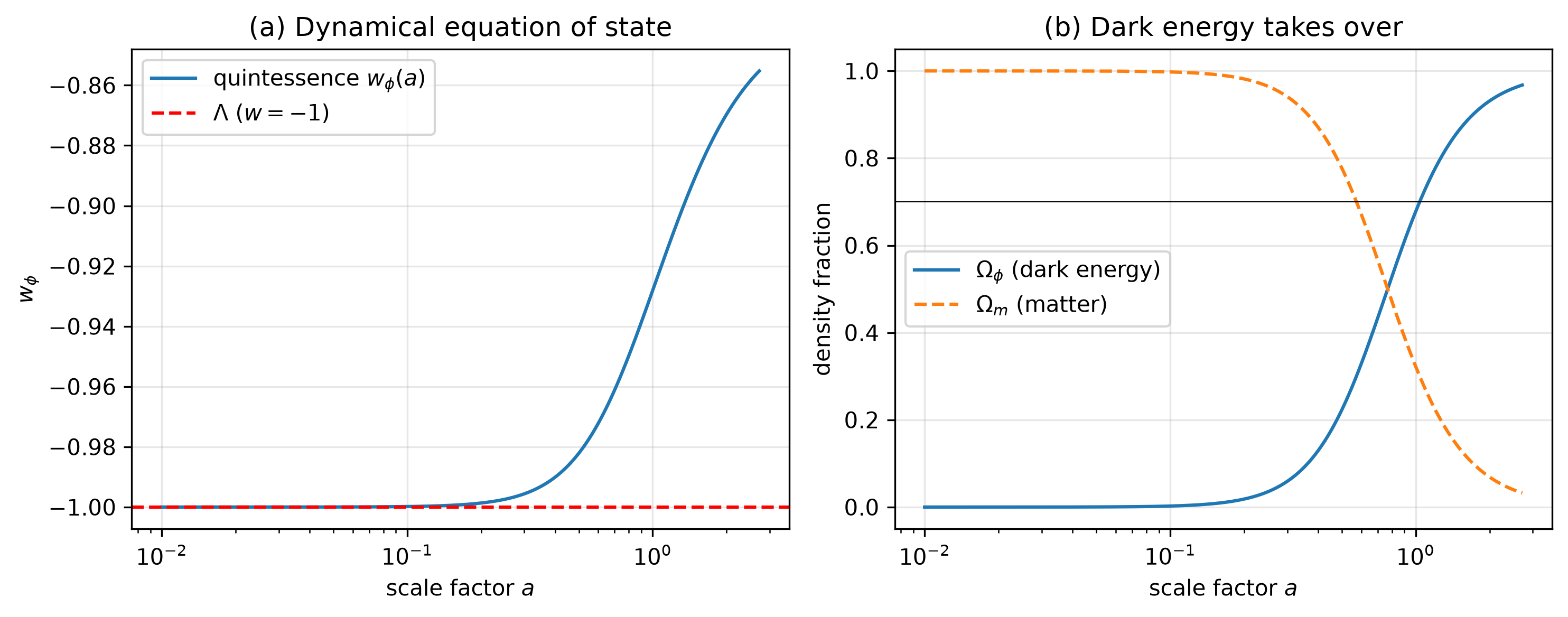
The same Schwarzschild-Verhave machinery, extended into a cosmological setting: a new manifold.cosmology module (pure NumPy) that studies dark energy three ways. The middle one bridges straight back to the black hole — adding a cosmological constant term −Λr²⁄3 to this metric's own lapse f(r) wraps a de Sitter horizon around the regular black hole at r ≈ √(3⁄Λ). Eleven new physics tests bring the suite to 17 passing.
From notebook to package
- Source: began as standalone research scripts (solver, regular-BH explorer, LaTeX write-up).
- Refactor: split computation from plotting so the solver imports cleanly with no side effects.
- Verify: added a pytest suite covering known physical limits and numerical convergence.
- Ship: published public with a tagged v0.1.0 release — preprint PDF and figures attached.